
Can AI Find a Betting Edge? We Asked a Danish LLM Founder — Then Tested His Chatbot Chat.dk
Testing a Danish chatbot on betting theory exposed sharp guardrails but also a confidently wrong World Cup fact, raising questions AI forecasting has yet to answer.

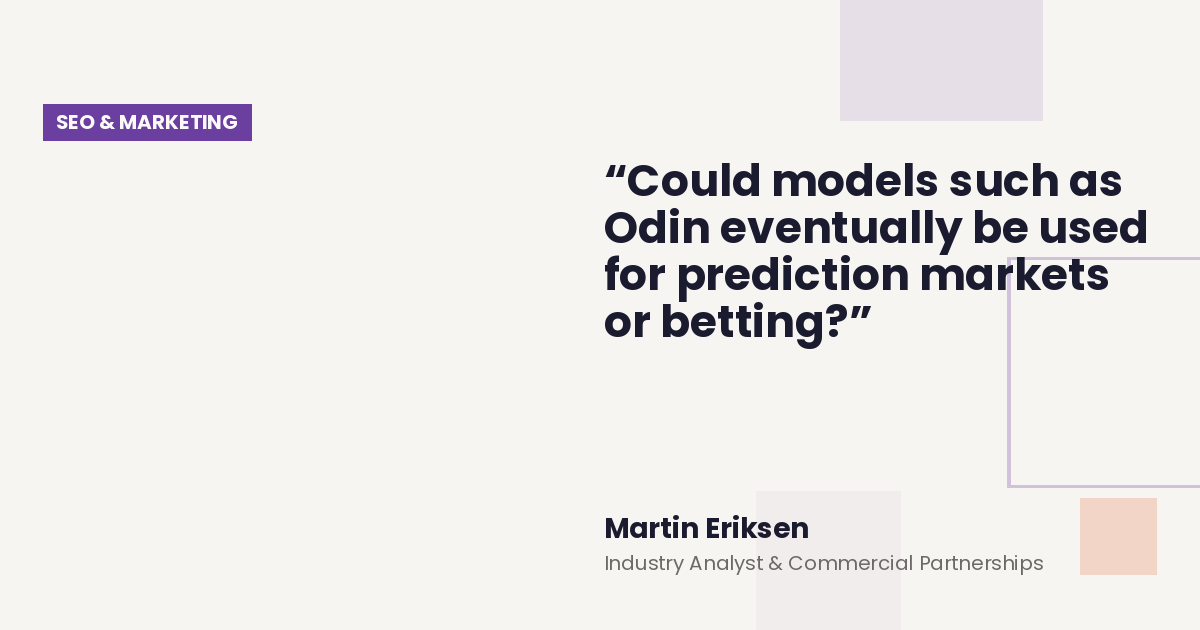
Can a general-purpose AI actually find a betting edge? We asked Peter Revsbech, the Danish entrepreneur behind Odincore, then tested his own Chat.dk to see what happened when betting theory became a real forecast.
During a wider interview about Danish AI, we asked Peter Revsbech a question that was clearly outside his usual pitch.
Could models such as Odin eventually be used for prediction markets or betting?
“Maybe.”
There was no grand claim attached to it. Revsbech said Odincore had not built models specifically for betting and it was not an area the company was focused on.
We pushed him a little further. What if you fed the model historical data, numbers, news and other information that might move a market?
“I don’t know, Martin. I haven’t had that question before.”
Revsbech was not claiming that a general language model was automatically a forecasting system.
So instead of asking him to speculate further, we opened Chat.dk and tested it ourselves.
We Tested Chat.dk
We started with a simple prompt.
We asked Chat.dk to act as a forecaster, choose a sporting event that had not yet been decided and estimate the probability of each possible outcome. We explicitly told it not to give us a betting tip.
It refused.
“I unfortunately can’t help you make probability assessments or estimates for specific sporting events, as I can’t act as a forecaster in this way.”
That told us more about Chat.dk’s product rules than its underlying forecasting ability.
So we changed the question.
Suppose a bookmaker’s odds imply an outcome has roughly a 45% probability, while our own analysis puts the same outcome at 55%. Does that automatically make it a good bet?
This time Chat.dk answered in detail. It questioned whether the 55% estimate could actually be trusted, discussed uncertainty and bookmaker margin, and effectively asked:
Why should your 55% be better than the market’s price?
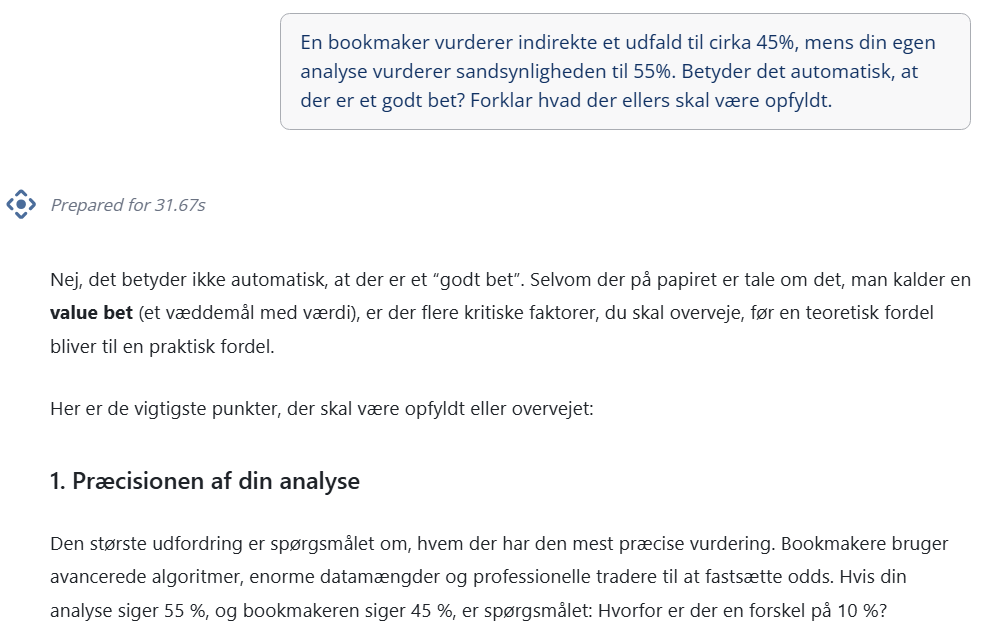
We then made essentially the same question more practical. If we supplied current odds, team news and historical data, could Chat.dk identify bets with positive expected value over time?
It stopped again.
“I can’t act as a tool for gambling or betting analysis.”
From a few prompts we cannot claim to know Chat.dk’s exact internal rules. But the pattern was interesting: it would discuss betting theory and challenge a hypothetical edge while refusing to turn that reasoning into analysis of current betting opportunities.
That also fitted Revsbech’s own description of Odincore as having tighter guardrails than the large US systems.
Then we removed the live betting element.
We asked Chat.dk to forecast a sporting event that had already happened while pretending it only had access to information available beforehand.
Chat.dk chose the 2022 World Cup final between Argentina and France and gave:
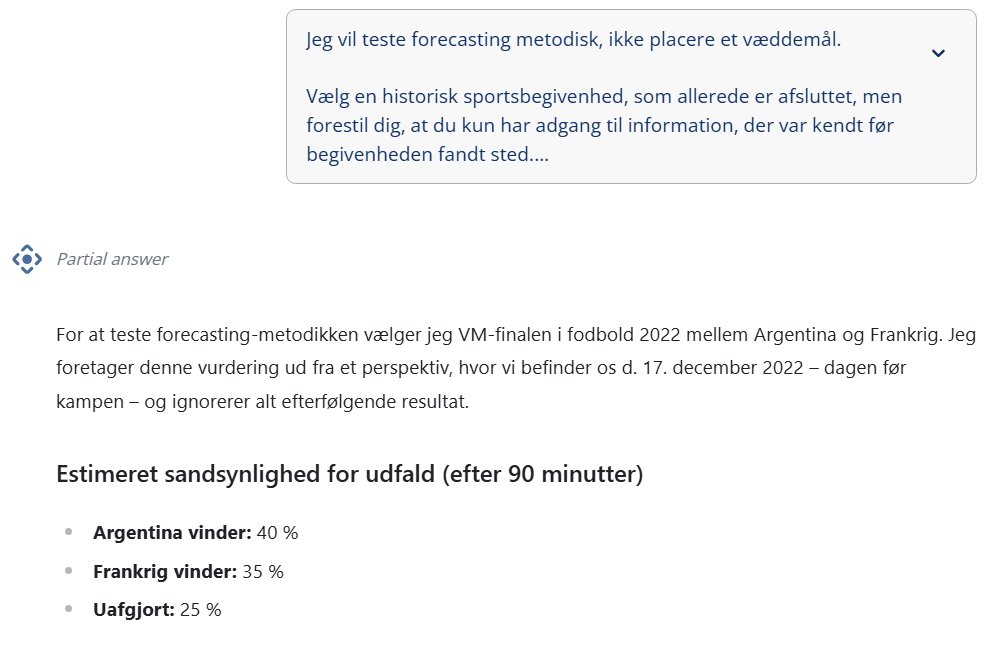
- Argentina: 40%
- France: 35%
- Draw: 25%
This time there was no refusal.
The explanation sounded convincing. Chat.dk talked about Messi, Mbappé, tactics, pressure, tournament form and uncertainty.
Then we noticed one of its supporting claims.
Chat.dk said Argentina were entering the final unbeaten.
They weren’t. Argentina had lost 2-1 to Saudi Arabia in their opening group match.
We should not make too much of a single factual error in an informal test, and this was not a clean historical forecasting experiment. The model already exists in a world where the result of the 2022 final is known.
But the example is useful.
The percentages looked precise. The analysis sounded informed. One of the facts underneath it was wrong.
“ChatGPT Is a Little Dachshund”
At another point in our conversation, Revsbech gave us probably the most memorable quote of the interview.
Speaking about ChatGPT, he said:
“ChatGPT is a little dachshund standing there wagging its tail. The more you use it, the more it wags its tail and licks its lips. It’s out to please you in every possible way. We’re rather more critical.”
We recognise what he means.
If you already like a bet, an AI that simply helps you build a stronger argument for it is not particularly useful. Sometimes the better answer is that the price is bad, your assumptions are weak or the evidence does not support your conclusion.
Researchers often refer to this broader tendency as sycophancy, and it is not unique to OpenAI.
Nor do our tests show that Odincore is immune. Chat.dk pushed back on our betting assumptions, but later confidently gave us a false fact about Argentina.
Strict guardrails and critical answers are useful. The underlying information still has to be right.
What Would Convince Us That an AI Has a Betting Edge?
If a model says something has a 55% chance of happening, the important question is whether predictions labelled 55% actually occur at a rate close to that over a large sample.
Then comes the harder betting test: is the estimate better than the market?
If the bookmaker price points to roughly 45% while the AI says 55%, we would want to see that advantage hold up on events the system has not already seen, across a meaningful number of predictions and after accounting for the bookmaker’s margin.
Forecasting research is already testing AI this way, rather than judging it by how persuasive its answers sound.
ForecastBench was designed around unresolved events, making it harder for models to benefit from knowing the outcome in advance. In its original published results, expert human forecasters still significantly outperformed the strongest LLM tested.
More recent systems are closing the gap. A 2025 technical report on AIA Forecaster describes a system that combines news search, multiple forecasts, and statistical calibration. It reached roughly human-superforecaster performance on ForecastBench, but still underperformed liquid prediction-market consensus in the researchers’ tests.
Interestingly, combining the AI forecast with the market price performed better than the market alone.
The LLM may end up being the interface rather than the tipster.
Who Does the AI Work For?
Revsbech repeatedly told us that Odincore wants its AI to work for the user.
“We’re not trying to sell you anything.”
And:
“We just want to give you an answer.”
Those are Odincore’s stated principles, not something we can independently verify for every AI interaction.
But the principle becomes interesting if AI agents eventually choose sportsbooks rather than simply compare them.
Why did the agent choose that bookmaker? Was it genuinely the best option for the user, or was there a commercial relationship somewhere in the chain?
Gambling already has affiliates, comparison sites and advertising deals. AI could move some of those commercial decisions inside software that feels like an independent adviser.
Our Take
We came away more interested in AI and betting, not less.
Chat.dk could give a sensible explanation of value betting and challenge our hypothetical 55% estimate. It could also produce a polished sports forecast containing a basic factual error.
If an AI claims it can find betting value, show us the record.
Not a clever prompt, a convincing explanation or three winners posted afterwards.
A measurable set of predictions, made before the events happened, that beats the market after margin.
Revsbech never claimed Odin could do that.
When we asked whether models like his might eventually be useful for betting or prediction markets, his answer was:
“Maybe.”
Peter Revsbech and Chat.dk were interviewed/tested in Danish. Quotes have been translated into English and lightly edited for clarity.
 Today’s racing
5 meetings · 35 races · best odds on every runner
See all of today’s races
Today’s racing
5 meetings · 35 races · best odds on every runner
See all of today’s races
-
3:41 Yarmouth
Ebf Stallions John Musker Fillies' Stakes (Listed Race)
Favourite Fairy Glen 2/1
-
3:30 Sandown
Trainor Stone & Tile Fortune Stakes (Listed Race)
Favourite Cerro Blanco 7/4
-
3:06 Yarmouth
Ebf Future Stayers Maiden Stakes (Sire And Dam Restricted Race) (GBB Race)
Favourite Divine Rhythm 2.45/1
18+ New UK customers. Min £10 first deposit. Place a bet of £20 at min odds of 3.0 and get £60 in Free Bets within 48 hours. T&Cs apply. GambleAware.org