
Link building: what a backlink is worth, and where iGaming gets it wrong
Bazoom's Kristoffer Krog on pricing a backlink, vetting publishers, why volume fails in iGaming, and what AI search changes about links and mentions.

Few things in SEO are argued about as much as links, and few are bought as steadily. Google has spent years playing them down. Gary Illyes told Pubcon in 2023 that people overestimate them and that they had not been a top-three ranking factor “for some time” (Search Engine Land).
The money has not followed the guidance. And when Ahrefs tested Google’s claim across a million search results, referring domains still came out as the strongest link metric it measured, well ahead of Domain Rating, though Ahrefs itself calls even that correlation a weak one (Ahrefs). Whatever the argument, pages that rank are still pages that acquired links.
One of the companies helping marketers acquire them is Bazoom, which began in Denmark as a straightforward link-building offer and now runs a marketplace reaching more than 80,000 media outlets, with over 80 staff across Aarhus, Copenhagen and Miami.
What sits behind the listings is people: an in-house outreach team that vets publishers and decides when to close the door, media managers who benchmark prices against the platform’s own data, and client managers on hand around the clock, with the text written, approved and published through the same workflow.
A marketplace staffed by people rather than a list you filter is now the standard the category works to. Its customers include a large share of the UK gambling affiliate market, which makes it an unusually good vantage point on how SEO money is actually spent.
Here Kristoffer Krog, Bazoom’s Head of Global Partnerships, shares with Gambler Media what separates a £200 link from a £1,500 one, why treating link building as a volume game fails, and what AI search is already changing.

Why a fragmented SEO market was the opening
We started with a relatively straightforward link-building offering in Denmark, but the opportunity became much bigger once it became clear how fragmented and inefficient the market was. SEO teams were working across agencies, individual publishers, spreadsheets and several different marketplaces just to build a campaign. We were part of a mother-organisation but quickly went our own way and changed the name to Bazoom, to become specialised in only link building.
What was actually broken about traditional link building
The biggest problem wasn’t necessarily that link building was too expensive. It was inefficient and difficult to scale.
As a client you would identify sites, find contact information, email publishers, negotiate prices, agree on content, follow up, wait for publication and then document everything in spreadsheets. Multiply that by hundreds or thousands of links across several markets and it was an operational problem.
We wanted to remove a lot of that friction. Our customers can see the inventory, metrics, prices and available products before ordering. Content and publication can be handled through the same workflow.
Another important point is access. One of the things we’ve seen from our own competitor analysis is that a significant part of Bazoom’s inventory isn’t available through other major marketplaces. So the value isn’t simply making an existing process faster — it’s also having the right supply that would otherwise require many different relationships and platforms.
“The biggest problem wasn’t necessarily that link building was too expensive. It was inefficient and difficult to scale.”
How we decide whether a site is worth a link
Metrics are useful filters, but they need context. You want to look at things such as organic traffic and its development over time, ranking keywords, topical relevance, geographic relevance, the quality and history of the domain, its outbound-link profile and whether the website appears to exist primarily for selling links. Those are some of the ground rules our team looks at.
Our biggest team in-house is our outreach team, with a lot of experience and SEO know-how, they know what to look for. And when to close the door.
We also offer publishers to apply for our media portal and enrol sites on their own to be featured in our marketplace.
Red flags would include obviously manipulated metrics, unexplained traffic patterns, extremely poor or mass-generated content, excessive irrelevant outbound links and sites that have effectively become link farms.
80,000+
Media outlets reachable through Bazoom’s marketplace
80+
Bazoom staff across Aarhus, Copenhagen and Miami
Bazoom
What a backlink should cost in 2026
It is and always will be, very difficult to put a universal “correct” price on a backlink. A lot of it is dictated by the publisher and owner of the site.
As a client you’re buying access to a publication and its audience, authority varies enormously. GEO, niche, organic visibility, editorial standards, exclusivity.
The question is probably what the link is worth to the client’s campaign.
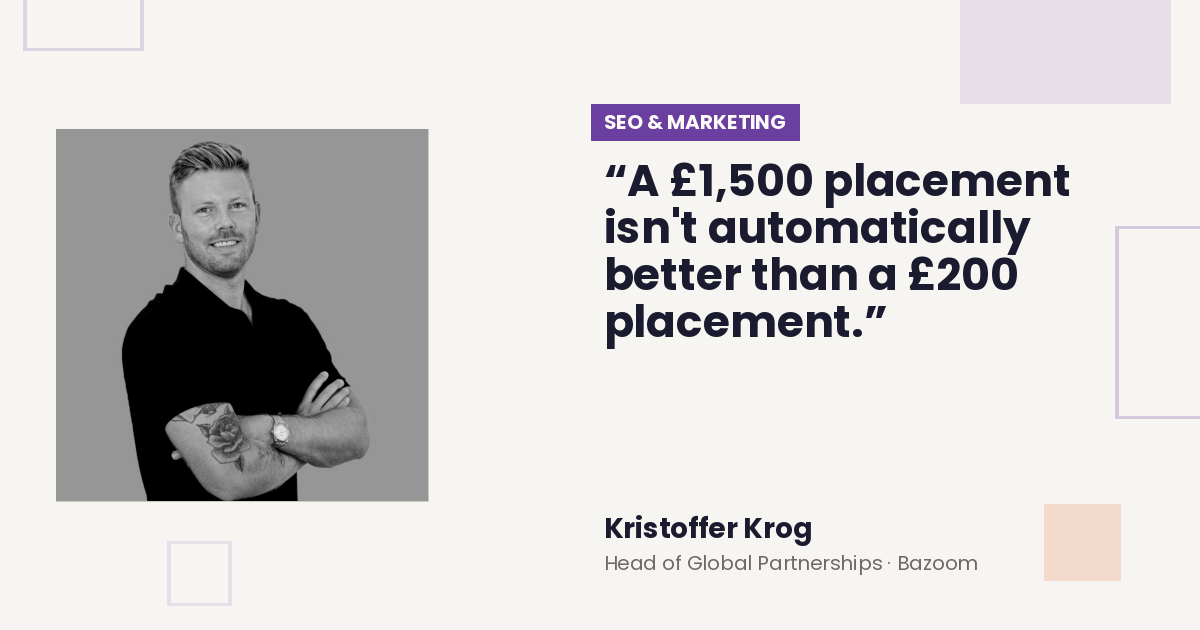
A £1,500 placement isn’t automatically better than a £200 placement. If the expensive site has little topical relevance and doesn’t contribute meaningfully to the strategy, you’re paying for a metric or a brand name rather than an outcome.
The SEO value will always be there if you’re choosing the right link, but at very different levels and aspects.
Furthermore, our team of outreachers, media managers and upload teams are all trained to spot prices that are out of the ordinary – and they get help from our platform, that automatically benchmarks against the industry, our existing offerings, and metrics to give an estimate of what the price should be, from hundreds of thousands of lines of data.
“A £1,500 placement isn’t automatically better than a £200 placement.”
Where iGaming brands get link building wrong
I think one major mistake is treating link building as a volume game. Sure it works for some companies. Especially ones that are very well established and have been around for a long time – but that’s only because they have to match their backlink profile and keep their rankings high, as they’ve always been used to.
The strongest campaigns tend to be much more deliberate about competitor gaps, topical relevance, geographic relevance, link diversity and where authority is actually missing.
That is one of the reason we launched backlink-gap.bazoom.com — instead of starting with “we need 50 links this month,” start with “where are our competitors earning authority that we aren’t?”
Another mistake is separating links completely from content, PR and brand. The industry is moving towards a much broader definition of off-page SEO, where brand mentions, editorial coverage, link insertions, PR articles and traditional backlinks can all play different roles.
All link types that we also offer, as we wanted to gather everything in one place. Everything you need to rank efficiently.
“I think one major mistake is treating link building as a volume game.”
Google’s guidelines, paid links, and where the line sits
If you take Google’s official guidelines on backlinks, you’d think almost all types of links are manipulative. But in reality the whole purpose of adding links is to improve rankings for all sides. For the publisher, it’s a credible add-on to their content, and for the linked domain it’s a vote signal. Using that strict logic, any link could be considered manipulative.
We haven’t seen clients being penalised for building links, as the way we treat backlinks is actually aligning with Google’s official guidelines – placing the link in a most natural context, not forcing exact match anchors where they don’t belong, focusing on guest post content value, publishing on relevant and ‘alive’ domains that have natural traffic rather than being manipulated for DR and fake ranks.
Building links strategically gives a more organic look to the backlink portfolio and makes sure there is enough diversity and value. The “sponsored” factor is actually just paying for the guarantee that the link will stay live long enough and published in a quality content. And that’s the reason why Google allows link building to thrive, as long as you’re not abusing the process.
“Using that strict logic, any link could be considered manipulative.”
What AI search changes about links and mentions
AI/LLMs don’t have backlink databases or active algorithms that evaluate links the way Google does, so they look at backlinks from a different perspective. When we make a strategy to improve AI visibility we primarily focus on context around the link and the search query. There are other factors that play a big role in AI logic, like credibility of a publisher in the niche, and if the client’s link/keyword gives a solution or answer to a certain query. LLMs treat everything as conversational search and need a quick and trusty solution.
It’s important to remember that AI still relies heavily on SERP scraping and inventory, so building ‘traditional’ links is still a first-hand way to enter the algorithms of all search engines.
We like to apply hybrid content and link strategies that trigger interest of both SERP and AI crawlers at the same time, as it showed better results than doing it separately.
£200
Lower-cost placement
Can outperform a pricier link if the site has strong topical relevance and contributes to the strategy.
£1,500
Premium placement
Worth less if the site has little topical relevance, meaning the client pays for a metric or brand name rather than an outcome.
Bazoom
Why links will still matter in 2030
I think the definition of link building will change more than links themselves disappear.
Links remain one of the clearest ways the web establishes relationships between websites, content, brands and information. But authority increasingly isn’t represented by one signal alone.
In five years we may talk less about “building 50 backlinks” and more about building authority across the web. I agree with that. I believe a brand’s overall authority should still be the main focus point.
Will links still be an important part of that for the next five years? Yes. Will it be done differently? Perhaps.
My five years at Bazoom, I’ve heard the same story. Links are dead. Links will die. Links have no meaning. But we sell more links than ever. The demand is higher than ever. And quality matters more than ever. So I don’t think backlinks will disappear. I’d bet that the industry becomes less obsessed with the backlink as an isolated unit, and more interested in the complete brand authority.
“But we sell more links than ever. The demand is higher than ever. And quality matters more than ever.”
On scaling Bazoom, by founder Nicolai Klausen
The most challenging part of scaling was building the organisation at the same pace as we we’re building the company. And that was in both ends. So either we were too few people handling too many tasks or we increased the staff but didn’t get sales in as expected. You have to take 2 steps forward and 1 step backwards a lot of times to build a company in the pace as we aim to do it. And take some risky bets where we were okay taking a hit, either to get the win or to get the experience to move forward in another direction.
In general I don’t think of things as hard, i think of them as challenges and something that we learn from when we face them. But the biggest changes was definitely giving away the keys and hiring an external CEO with more strategic and administrative skills than myself and then on top of that moving to the US to start up an entirely new market for us at that time. Furthermore we tried to get in other C-level employees to fill the gap i left, but that was a part where we as an organisation didn’t succeed at all and therefore had to go another round and make the organisation lean again to be able to grow again.
How I would build a new UK gambling affiliate today
I wouldn’t start by spending the entire budget trying to replicate the backlink profile of an established casino affiliate. I’d build brand, content and authority simultaneously.
The content needs to offer something beyond another rewritten “best UK casinos” page. Original research, proprietary data, tools, genuine expertise, comparisons and content that other publications actually have a reason to reference become much more valuable.
I would still care about traditional search, because Google will always remain important. But from day one I’d also think about whether the brand is becoming visible beyond it’s own website.
For off-page SEO, I’d probably invest in a diversified approach: Backlinks from top tier sites with established heritage, and highly relevant sites fitting the industry and niche.
And then have a strong focus on competitor-gap opportunities, editorial placements, digital PR and brand mentions.
“I wouldn’t start by spending the entire budget trying to replicate the backlink profile of an established casino affiliate.”
 Today’s racing
5 meetings · 37 races · best odds on every runner
See all of today’s races
Today’s racing
5 meetings · 37 races · best odds on every runner
See all of today’s races
-
3:00 Newmarket
Tattersalls Stakes (Registered As The Somerville Tattersall Stakes) (Group 3)
Favourite Great Balls O'Fire 12/5
-
3:07 Listowel
Listowel Races Supporters Club Lartigue Hurdle (Handicap) In Memory Of John Molyneaux (Listed)
Favourite Beauvallon 3/1
-
3:35 Newmarket
Jockey Club Rose Bowl Stakes (Listed Race)
Favourite Gregory 8/11
18+ New UK customers. Min £10 first deposit. Place a bet of £20 at min odds of 3.0 and get £60 in Free Bets within 48 hours. T&Cs apply. GambleAware.org